Squirrels: A Wildlife Handbook, Second Edition
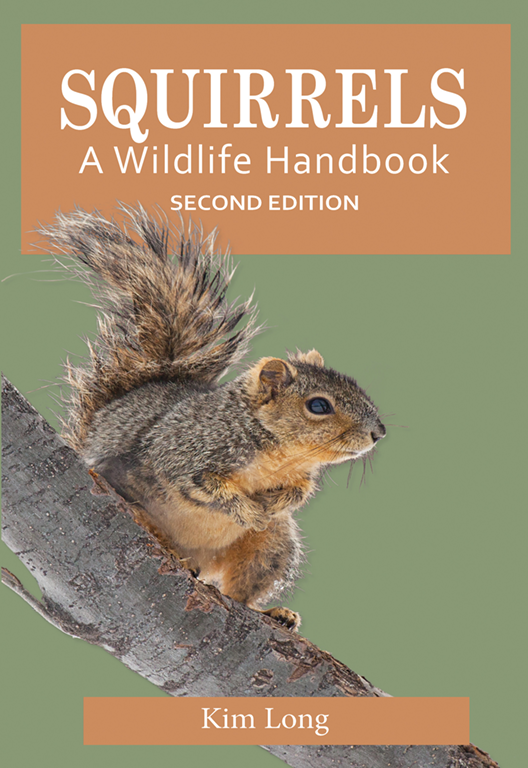
Publication date: October 1, 2026.
Print only. 224 pages.
ISBN: 978-1-7361476-5-8

www.proximopress.com
EMAIL info@proximopress.com
EMAIL info@squirrelswildlifehandbook.com
____________________________________________________________
Here's what readers had to say about the first edition of Squirrels ...
“When people ask me to suggest a popular book on squirrels, this is the one that I am now recommending.” -- Vagn Flyger (Professor emeritus, University of Maryland)
“I learned a lot from this book. Unless you’re already a walking encyclopedia of Rodentia, you may also find it a worthwhile read.” – Squirrel Lover’s Club
“As the author point out in his introduction, squirrels, as one of the less glamorous members of the animal kingdom, may be overlooked because they are so common ... This handbook should add to the knowledge and enjoyment of squirrel watchers everywhere” -- Libraries Unlimited
“As it turns out, just about everybody is interested in squirrels, though they might not realize it. Spend just a few minutes with Long’s book, and you’ll find you are among those who find these little rodents fascinating.” – Statesman Journal (Salem, Oregon)
“Squirrels is an excellent source of information for the truly curious. It is well organized and full of well-done graphics, effectively covering such things as nesitng and mating habits, diet, and reproduction.” – Online review
“Total expense of this transaction ended up being a good buy. Interesting book given as a gift; it was a real hit with my squirrel-loving sister.” – Online review
“LOVE THIS BOOK! Very informative, with a clear and easy to understand style of writing; avoiding complex vocabulary and jargon. A book that is accessible to a wide audience. The enhanced storytelling style provides facts without overwhelming the reader. So much fun to read! I read it aloud, to my husband, every time we sit on our back deck....watching squirrels and birds. Definitely adding more of Kim Long's books to my wish list!” – Online review
______________________________________________________________
First published in 1995, Squirrels: A Wildlife Handbook, Second Edition, is now updated and available as of October 2026.
Tree squirrels are plentiful across most of North America, having expanded outward from their natural range in forests. The most recognizable wild animal because of their presence in cities, parks, and backyards, they present a remarkable opportunity to see wild animals up close. They are the most viewed wild animal not counting birds. Squirrels: A Wildlife Handbook, Second Edition is updated and expanded from the first edition, with color photographs, graphs, charts, and detailed graphics that explore the day-to-day existence of these scampering mammals -- anatomy, physiology, species identification, behavior, reproduction, diet, tracks, predation, environmental threats, and much more. Squirrels also examines the sometimes unwanted activity of squirrels in backyards and gardens, where their frisky antics can be offset by their appetite for vegetables, the bark they strip from ornamental trees, and their unwanted incursions into attics, garages, and crawl spaces.
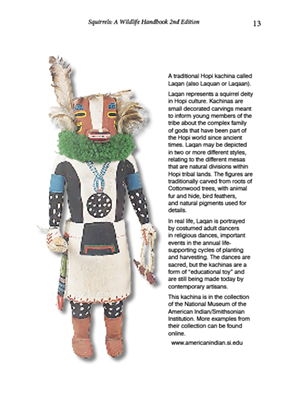
Additional information provides the real and mythological background of these tree dwellers, with illustrations representing their significance in past eras. Taxonomy provides the story of the family tree that generated the squirrels we recognize today; mythology and folklore introduce squirrels and their unique connection to Native Americans and other world cultures. Some species and subspecies of North American tree squirrels are threatened by development and other activities that reduce their range or otherwise increase risks.
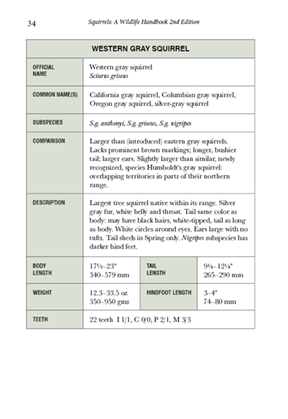
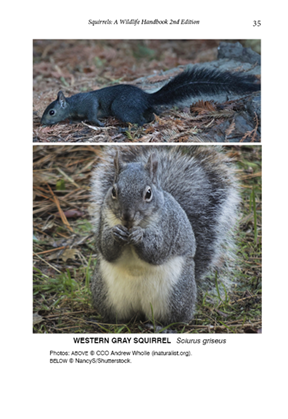
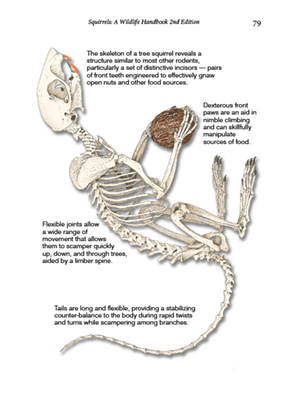
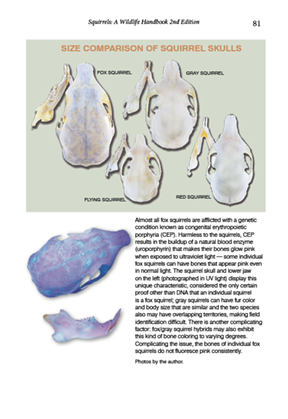
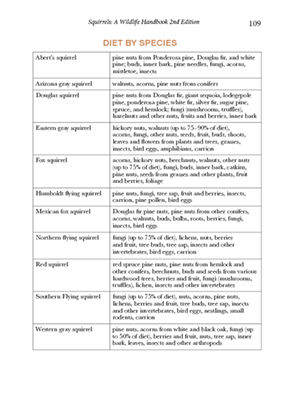
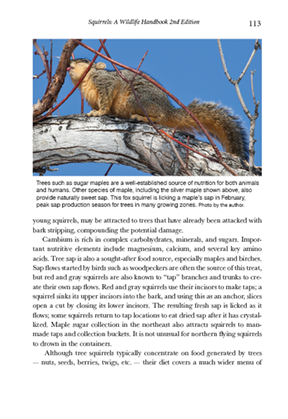
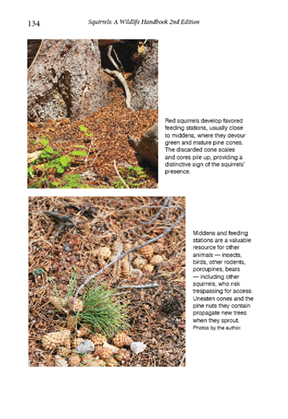
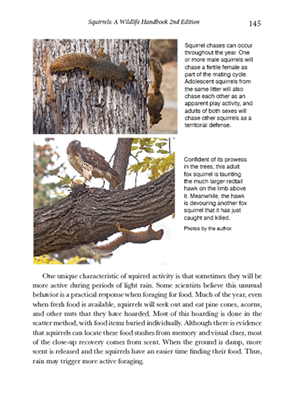
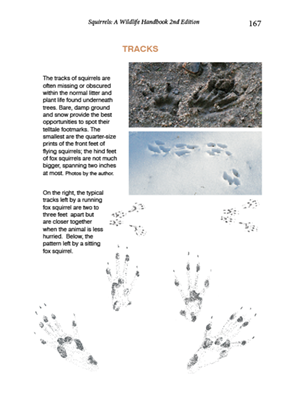
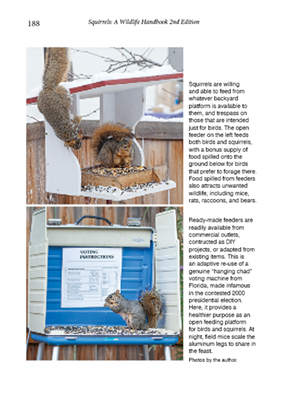
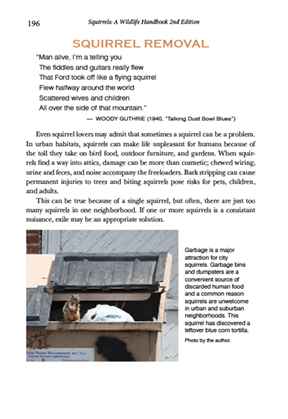
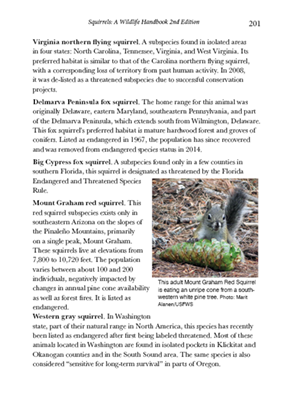
Sample pages below.
_______________________________________________________________
Thirty-one year ago ... the history of this book.
Squirrels: A Wildlife Handbook debuted in 1995, published by Johnson Books (Boulder, CO). It quickly established itself in bookstores and libraries, as well as bookshops in natural history museums, zoos, and national parks.
Squirrels was the initial title of a book series, the Johnson Nature Series, which eventually included Wolves (1996), Hummingbirds (1997), Owls (1998), Frogs (1999), Beavers (2000), and Prairie Dogs (2002). All of these titles are currently out of print (and the original publisher is no longer in business). Used copies can be found on abebooks.com, Amazon, and other Online book retailers.
In 1998, the first edition of Squirrels became the beta title for NetLibrary, a publishing startup that was the first venture to provide a digital lending system for libraries. NetLibrary only lasted a few years, but in 2002 its contents migrated to OCLC, a library industry service (started in 1967 and originally known as the Ohio College Library Center, the name morphed to the Online Computer Library Center). OCLC continues to the present but in 2010, the contents, including Squirrels, migrated once again, to EBSCO (an acronym for Elton B. Stephens Company), another company providing content and services to libraries.
EBSCO maintains a robust presence in the library sector today, including ebook versions of Squirrels and a few other Johnson Nature Series titles from this author. This content, however, is outdated and will be delisted soon.
Meanwhile, hundreds of libraries still hold print copies of the first edition, but we encourage readers to check out this new version because of the expanded and updated contents, including more graphics, many color illustrations, new color photos, and additional information that expands on the content in the first edition.
In between the two editions, a small experiment was launched by the author. Three editions of wall calendars featuring tree squirrels were published to test a potential market expansion (as print on demand copies, with Online sales only), to provide visual evidence of squirrels up to their familiar antics. Not enough interest to continue, but in the future, these calendars may pop up once again.
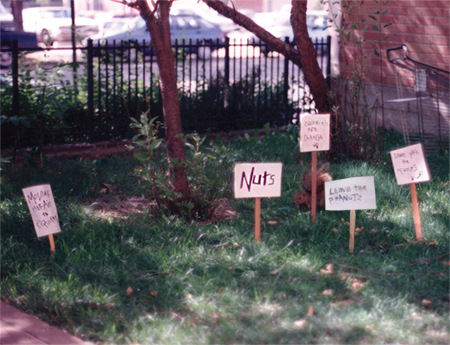
Squirrels: A Wildlife Handbooksupports wildlife and wild places and realizes that most people encounter more birds and squirrels than beavers or river otters. Feeding birds and squirrels is generally a good thing, but there can be unintended consequences. The snapshot below depicts the aftermath after an office of dedicated squirrel feeders moved their office to a new location. The local pampered squirrels were left behind.
The second edition of Squirrels has a bibliography of the major sources of information supporting the text, but does not include a list of citations from peer-reviewed journals and other non-book sources -- a space-saving decision by the author. Tthese citations are listed below for those seeking points of reference and more details about the original sources. Note that many of the listings may only be accessible through academic websites or other online services, many of these require subscriptions. If interested, check with a local public or academic library for availability and access.

_______________________________________________________________________
Citations for Squirrels: A Wildlife Handbook, Second Edition
Abrams, Marc D.; Scheibel, Michael S. A five-year record mast production and climate in contrasting mixed-oak-hickory forests on the mashomack preserve, long island, new york, usa. 2013, Natural Areas Journal, 33(1):99-104.
Ahl, Alwynelle S. Relationship of vibrissal length and habits in the sciuridae. 1987, Journal of Mammalogy, 68(4):848-853.
Allen, J.A.; Rowley, John. On seasonal variations in color in sciurus hudsonius. 1890, Bulletin of the American Museum of Natural History, vol 3: 41-44.
Archibald, Devan W.; Boutin, Stan; Fletcher, Quinn E.; Mcadam, Andrew. Sex-specific hoarding behavior in north american red squirrels (tamiasciurus hudsonicus). 2013, Journal of Mammalogy, 94(4):761-770.
Aresin, Maria. “God be with you, sir squirrel!” Pet squirrels between amorous play and animal appetite, c. 1100-1650. 2019, Animals and Courts, doi.org/10.1515/9783110544794-015
Ascoll, Davide; et. al. Two centuries of masting data for European beech and norway spruce across the european continent. 2017, Ecology, 98(5):1473.
Badyaev, Alexander. Moonlight flyers. 2019, Natural History, May.
Barber, Harold L. Gray and fox squirrel food habits investigations. Proceedings of the Annual Conference of the Southeast Association of Game & Fish Commissioners. 8:191-197.
Barthelmess, Erika. The effects of tannin and protein on feed preference in eastern grey squirrels. 2010, Ethology Ecology & Evolution, 13:115-132.
Barthelmess, Erika. Food preferences and food caching behavior in eastern gray squirrels (sciurus carolinenesis). 1990, Ph.D. thesis, Earlham College.
Benson, Etienne. The urbanization of the eastern gray squirrel in the united states. 2013, Journal of American History, December:691-710.
Berteaux, Dominique; Boutin, Stan. Breeding dispersal in female north american red squirrels. 2000, Ecology, 81:5/1311-1326.
Best, Troy L. Mexican fox squirrel (sciurus nayaritensis). 1995, Mammalian Species, 492:1-5.
Best, Troy L.; Riedel, Suzanne. Sciurus arizonensis. 1995, Mammalian Species, 496, 1-5.
Bird, Caitlin. Toothy squirrels could confuse crime sciences. 2018, Boston University Research/Forensic Science, 08/29.
Blakeslee, Barbara; Jacobs, Gerald H.; Neitz, Jay. Spectral mechanisms in the tree squirrel retina. 1988, Journal of Comparative Physiology, 162:773-780.
Bleich, Vernon C. Abnormal coloration in sciurus carolinensis gmelin (eastern gray squirrel): albinism, leucism, or isabellinism? 2024, Prairie Naturalist, 56:N1-N4.
Boutin, Stan A.; Schweiger, Stefanie. Manipulation of intruder pressure in red squirrels (tamiasciurus hudsonicus): effects on territory size and acquisition. 2011, Canadian Journal of Zoology, February.
Brodin, Anders. The history of scatter hoarding studies. 2010, Philosophical Transactions of the Royal Society B, doi: 10,1098/rstb.2009.0217.
Broome, A.; Summers, R.W.; Vanhala, T. Understanding the provision of conifer seed for woodland species. 2016, Forest Research (UK).
Brown, Joel S. Distribution and diversity of squirrels on university and college campuses of the united states and canada. 2020, Journal of Mammalogy, 101(4):930-940
Casanovas-Vilar, Isaac; Dam, Jan van. Conservatism and adaptability during squirrel radiation: what is mandible shape telling us? 2013, PLOS ONE, 8(4), e61298, doi.org/10.1371/journal.pone.0061298
Chow, Pizza K.Y.; et.al. Analysis of scientific research with regard to the effect of squirrels on forest regeneration. 2023, Interactive Centre for Scientific Research about Squirrels (ICSRS) for Animal Aid.
Cox, Philip G.; Watson, Peter. Masticatory biomechanics of red and grey squirrels (sciurus vulgaris and sciurus carolinensis) modelled with multibody dynamics analysis. 2023, Royal Society Publishing, doi.org/10.1098/rsos.220587.
Cronk, Lee; Palombit, Ryne. Are people projecting racist stereotypes onto squirrels? 2024, Sapiens.
Cronk, Lee; Palombit, Ryne. Eastern gray squirrel (sciurus carolinensis) color morphs do not differ in aggressiveness. 2021, Acta Ethologica, 24:143-147.
Crowley, Sarah L.; Hinchliffe, Steve; McDonald, Robbie A. Killing squirrels: exploring motivations and practices of lethal wildlife management. 2017, Environment and Planning Ecology/Nature and Space, 0(0):1-24.
Cummings, Mary. Raising infant tree squirrels. 2004, Animal Advocates/Squirrel Rescue (Los Angeles, CA).
David-Gray, Zoe K.; Gurnell, John; Hunt, David M. Estimating the relatedness in a population of grey squirrels, sciurus carolinensis, using dna fingerprinting. 1999, Acta Theriologica, 44(3): 243-251.
Delgado, Mikel M.; Jacobs, Lucia F. Caching for where and what: evidence for a mnemonic strategy in a scatter-hoarder. 2017, Royal Society Open Science, doi: 10.1098/rsos.170958.
Diggins, Corinne A. Behaviors associated with vocal communication of squirrels. 2021, Ecosphere, 12(6):e03572. 10, 1002/ecs2.3572.
Digweed, Shannon M.; Rendall, Drew. Are the alarm calls of north american red squirrels (tamiasciurus hudsonicus) functionally referential? 2010, Behaviour, 147(9):1201-1218.
Digweed, Shannon M.; Rendall, Drew. Predator-associated vocalizations in north american red squirrels (tamiasciurus hudsonicus): to whom are alarm calls addressed and how to they function? 2009, Ethology, 115:1190-1199.
Digweed, Shannon M.; Randall, Drew; Imbeau, Teana. Who's your neighbor? Acoustic cues to individual identity in red squirrel, tamiasciurus hudsonicus rattle calls. 2012, Current Zoology, 58(5):758-764.
Dudderar, Glenn Raymond. A survey of the food habits of the gray squirrel (sciurus carolinensis) in montgomery country, virginia. 1967, M.S. thesis, Virginia Polytechnic Institute.
Eddington, Valerie; et.al. Graded alarm call behavior in wild fox squirrels (sciurus niger). 2024, Journal of the Acoustical Society of America, 155(2):1308-1314.
Edelman, Andrew J.; Koprowski, John L. Diet and tree use of abert’s squirrels (sciurus aberti) in a mixed-conifer forest. 2005, The Southwestern Naturalist, 50(4):461,465.
Emry, Robert J.; Thorington, Richard W., Jr. Descriptive and comparative osteology of the oldest fossil squirrel, protosciurus (rodentia: sciuridae). 1982, Smithsonian Contributions to Paleobiology, 47.
Essner, Richard L., Jr. Locomotion, morphology, and habitat use in arboreal squirrels (rodentia: sciuridae). 2003, Ph.D. thesis, Ohio University.
Essner, R.L., Jr. Morphology, locomotor behaviour and microhabitat use in north american squirrels. 2007, Journal of Zoology, 272:101-109.
Flaherty, Elizabeth; Ben-David, Merav; Smith, Winston P. Diet and food availability: implications for foraging and dispersal of prince of wales northern flying squirrels across managed landscapes. 2010, Journal of Mammalogy, 91(1):79-91.
Flyger, Vagn. The 1968 squirrel “migration” in the eastern united states. 1969, presentation at the Northeast Fish and Wildlife Conference, February.
Fogel, Robert; Trappe, James M. Fungus consumption (mycophagy) by small animals. 1978, Northwest Science, 52(1).
Fukushima, Toshihiko: et.al. Inertial tail effects during righting of squirrels in unexpected falls: from behavior to robotics. 2021, Integrative and Comparative Biology, 61(2):589-602.
Fusco, Nicole A.; et. al. Population genomic structure of a widespread, urban-dwelling mammal: the eastern grey squirrel (sciurus carolinensis). 2023, Molecular Ecology, 2023;00:1-12.
Gill, Victoria. Red squirrel numbers boosted by predator. 2018, BBC News, March 7.
Goheen, Jacob R.; Swihart, Robert K. Food-hoarding behavior of gray squirrels and north american red squirrels in the central hardwoods region: implications of forest regeneration. 2003, Canadian Journal of Zoology, 81:1636-1639.
Gomez, D.M.; Anthony, R.G.; Hayes, J.P. Influence of thinning of douglas fir forests on population parameters a diet of northern flying squirrels. 2005, Journal of Wildlife Management, v. 69, no. 4, p. 1670-1682.
Goodrow, Zoe. The effects of elevated population density on north american red squirrel (tamiasciurus hudsonicus) behavior. 1997, Behaviour and Conservation symposium (London).
Grant, Kerrin. Nutrition of tree-dwelling squirrels. 2009, Veterinary Clinics of North America Exotic Animal Practice, doi: 10.1016/j.cvex.2009.01.015.
Greene, Erick; Meagher, Tom. Red squirrels, tamiasciurus hudsonicus, produce predator-class specific alarm calls. 1998, Animal Behaviour, 55(3):511-518.
Greenwood, Veronique. Flying squirrels that glow pink in the dark. 2019, The New York Times, 02/01.
Gustafson, Eric J.; Vandruff, Larry W. Behavior of black and gray morphs of sciurus carolinensis in an urban environment. 1990, The American Midland Naturalist, 123:186-192.
Hedwall, Shaula J.; Chambers, Carol L.; Rosenstock, Steven S. Red squirrel use of dwarf mistletoe-induced witches’ brooms in douglas-fir. 2010, Journal of Wildlife Management, 70(4):1142-1147
Howard, J.M. Influence of thinning of douglas-fir forest on population parameters and diet of northern flying squirrels. 2005, Journal of Wildlife Management, 69:1670-1682.
Hunter, J.S. Revision of the american flying squirrels. 1918, North American Fauna.
Jacobs, Gerald H.; Birch, David G.; Blakeslee, Barbara. Visual acuity and spatial contrast sensitivity in tree squirrels. 1982, Behavioural Processes, 7:367-375.
Jenkins, Farish, Jr.; Krause, David W. Adaptations for climbing in n.a. multituberculates (mammals). 1983, Science. 220:712-14.
Jensen, Paul G. Ecology of american martens in northern hardwood forests: resource pulses and resource selection across temporal and spatial scales. 2012 Ph.D. thesis, McGill University.
Johnson, K.M.; Boonstra, R.; Wojtowicz, J.M. Hippocampal neurogenesis in food-storing red squirrels: the impact of age and spatial behavior. 2010, Genes Brain Behavior, 9(6): 583-91.
Kaya, Emrah; Kamalak, Adem. Potential nutritive value and condensed tannin contents of acorns from different oak species. 2012, Kafkas Universitesi Veteriner Fakultesi Dergisi. doi: 10.9775/kvfd.2012.7053.
Keller, Michael Ryan. Fox squirrel response to bark calls. 2014, Honors thesis paper, Butler University.
Kelly, John. Stress test: scientists go inside the brains and bloodstreams of squirrels. 2021, The Washington Post, 04/10.
Kinkead, Eugene. The squirrels of central park. 1974, The New Yorker, 09/09, 101-112.
Klippel, Walter E.; Synstelien, Jennifer A. Rodents as taphonomic agents: bone gnawing by brown rats and gray squirrels. 2007, Journal of Forensic Science, Jul;52(4):765-73.
Kohler, Allison M.; Olson, Erik R.; Martin, Jonathan G.; Anich, Paula Spaeth. Ultraviolet fluorescence discovered in new world flying squirrels (glaucomys). 2019, Journal of Mammalogy, 100(1)21-30.
Koprowski, John L. Tamiasciurus hudsonicus (pine squirrel): a technical conservation assessment. 2005, USDA Forest Service/Rocky Mountain Region/Species Conservation Project.
Koprowski, John L. Sciurus carolinenses (eastern gray squirrel). 1994, Mammalian Species, 480:1-9.
Langley, Ricky; Haskell, Marilyn; Hareza, Dariusz; Mack, Karin. Rodent bite injuries presenting to emergency departments in the united states, 2001-2015. 2021, Journal of Environmental Health, 83(7):18-24.
Lilly, Marie V.; Lucore, Emma C.; Tarvin, Keith. Eavesdropping grey squirrels infer safety from bird chatter. 2019, PLOS ONE, 14(9), doi.org/10.1371/journal.pone.0221279.
Linders, Mary J.; Stinson, Derek W. Washington state recovery plan for the western gray squirrel. 2006, Draft report/Washington Department of Fish and Wildlife/Wildlife Program.
Marks, A. Sciurus aberti: abert’s squirrel. 2014, Animal Diversity Web.
Matthew, W.D. On the osteology and relationships of paramys, and the affinities of the ischyromyid. 1910, Bulletin of the American Museum of Natural History, 56.9,32P(1181) :14.71.
McCleery, Robert A.; et.al. Lopez, Roel R.; Silvy, Nova J.; Gallant, Daniel L. Fox squirrel survival in urban and rural environments. 2010, Journal of Wildlife Management, 72(1):133-137, doi.org/10.2193/2007-138.
Mcquade, Denise; Williams, Ernest. Cues used for localizing food by the gray squirrel (sciurus carolinensis). 1986, Ethology, DOI: 10.1111/j.1439-0310.1986.tb00602.x.
McRae, Thaddeus R. A review of squirrel alarm-calling behavior: what we know and what we do not know about how predator attributes affect alarm calls. 2020, Animal Behavior and Cognition, 7(2):168-191.
McRobie, Helen R.; Moncrief, Nancy D.; Mundy, Nicholas I. Multiple origins of melanism in two species of north american tree squirrel (sciurus). 2019, BMC Evolutionary Biology, 19:140, doi.org/10.1186/s12862-019-1471-7
Menendez, Iris: et.al. A multi-layered approach to the diversification of squirrels. 2020, Mammal Review, 51:66-81.
Merwe, Marius van der; Brown, Joel S. The coexistence of fox (sciurus niger) and gray (s. caroliniensis) squirrels in the chicago metro area. 2005, Urban Ecosystems, 8:335-347.
Moncrief, Nancy D.; Hightower, Liberty. Prevalence and location of survivable skeletal injuries in two north american tree squirrels (sciurus). 2022, Journal of Mammalogy, 103(3):1-9.
Murrant, Meghan N.; et.al. Ultrasonic vocalizations emitted by flying squirrels. 2013, PLOS ONE, 8(8), e73045.
Nandini, R. Evolution of sexual size dimorphism in squirrels. 2011, Ph.D. thesis, Auburn University.
Nelson, Danielle D.; et.al. Francisella tularensis infection without lesions in gray tree squirrels (sciurus griseus): a diagnostic challenge. 2014, Journal of Veterinary diagnostic Investigation, 26:312.
Nichols, Christopher P.; et.al. Drewe, Julian A.; Gill, Robin; Goode, Nigel; Gregory, Neville. A novel causal mechanism for grey squirrel bark stripping: the calcium hypothesis. 2016, Forest Ecology and Management, v.367; 12-20.
Nixon, Charles M.; Worley, D.M.; McClain, Milford W. Food habits of squirrels in southeast ohio. 1968, Journal of Wildlife Management, 32(2):294-305.
Orkin, Joseph D.; Pontzer, Herman. The narrow niche hypothesis: gray squirrels shed new light on primate origins. 2011, American Journal of Biological Anthropology, 144:617-624.
Ortiz, Janel L.; Muchlinski, Alan E. Food selection of coexisting western gray squirrels and eastern fox squirrels in a native california botanic garden in clarement, california. 2015, Bulletin of the Southern California Academy of Science, 114(2).
Pardo, Michael A.; Shields, William Michael. Eastern gray squirrels (sciurus carolinensis) communicate with the positions of their tails in an agonistic context. 2014, The American Midland Naturalist, doi: 10.1674/0003-0031-172.2.359.
Pardo, Michael. Tail Communication in the eastern gray squirrel, sciurus carolinensis. 2012, Honors thesis, SUNY.
Parker, Tommy S.; Nilon, Charles H. Gray squirrel density, habitat suitability, and behavior in urban parks. 2008, Urban Ecosystems, 11:243-255.
Patterson, Thomas. The percentage of trees bearing cones as a predictor for annual longleaf pine cone production. 2021, Frontiers in Forests and Global Change, 4(718218),
Pelech, Shawna A.; Smith, James N.M.; Boutin, Stan. A predator’s perspective of nest predation: predation by red squirrels is learned, not incidental. 2010, Oikos, 119:841-851.
Perlut, Noah G. Long-distance dispersal by eastern gray squirrels in suburban habitats. 2020, Dune/Environmental Studies faculty publications, 39.
Peterson, Andrea. Are squirrels a bigger threat to the power grid than hackers? 2016, The Washington Post, 01/12.
Pokines, James T.; et.al. The taphonomic effects of eastern gray squirrels (sciurus carolinensis) gnawing on bone. 2016, Journal of Forensic Identification, 66(4).
Polo-Cavia, Nuria; Vazquez, Zoraida; de Miguel; Francisco Journal Asymmetry in food handling behavior of a tree-dwelling rodent (sciurus vulgaris). 2015, PLOS ONE, 10(2): e0118233. doi:10.1371/journal.pone.0118233
Poshthumus, Erin E.; Koprowski, John L.; Steidl, Robert Journal Red squirrel middens influence abundance but not diversity of other vertebrates. 2015, PLOS ONE, 10(4), e0123633. doi:10.1371/journal.pone.0123633
Preston, Stephanie; Jacobs, Lucia F. Mechanisms of cache decision making in fox squirrels (sciurus niger). 2009, Journal of Mammalogy, 90(4):787-795.
Pretzlaw, Troy: et. al. Red squirrels (tamiasciurus hudsonicus) feeding on spruce bark beetles (dendroctonus rufipennis): energetic and ecological implications. 2006, Journal of Mammalogy, 87(5):909-914.
Pyare, Sanjay; Longland, William S. Interrelationships among northern flying squirrels, truffles, and microhabitat structure in sierra nevada old-growth habitat. 2002, Canadian Journal of Forest Research, 32:1016-1024.
Reinhold, Linda Melissa. Photoluminescence in fur. 2023, Master of Philosophy thesis, College of Science and Engineering, James Cook University (Queensland, Australia).
Rimbach, Rebecca; et.al. Gray squirrels consume anthropogenic food waste most often during winter. 2023, Mammalian Biology, doi: 10.1007/s42991-022-00326-3.
Roberts, Laura. Red squirrels dying after picking up human bacteria from animal lovers who leave food out for them, wildlife experts have claimed. 2010, The Telegraph (UK), July 12.
Roper, Eric. Did a famed parks leader import gray squirrels to minneapolis – and have the red ones killed. 2023, The Minnesota Star Tribune, 4-21-2023.
Ryan, Loreen A.; Carey, Andrew B. Biology and management of the western gray squirrel and oregon white oak woodlands: with emphasis on the puget trough. 1995, USDA General Technical Report, PNW-GTR-348.
Salsbury, Carmen M. Distribution patterns of sciurus niger (eastern fox squirrel) leaf nests within woodlots across a suburban/urban landscape. 2008, graduate paper, Butler University, 15(4):485-496.
Sansom, Whitney. Eastern gray squirrel: identify and interpret tracks and signs. 2022, FW, Spring.
Shealer, David; Novak, John A.; Sunderlin, David. Foraging patterns of eastern gray squirrels (sciurus carolinensis) on goldenrod gall insects, a potentially important winter food resource. 2009, American Midland Naturalist, 142:102-109.
Shellhammer, Howard S. Douglas squirrels and sequoia regeneration. 1980, Giant Sequoia Ecology, National Park Service.
Short, Henry L. Composition and squirrel use of acorns of black and white oak groups. 1976, Journal of Wildlife Management, 40(3):479-483.
Siracusa, Erin; et. al. North american red squirrels mitigate costs of territory defense through social plasticity. 2019, Animal Behaviour, 151(29-42).
Siracusa, Erin; et.al. Red squirrel territorial vocalizations deter intrusions by conspecific rivals. 2017, Behaviour, doi 10.1163/1568539X-00003467.
Smallwood, Peter D.; Peters, William David. Grey squirrel food preferences: the effects of tannin and fat concentration. 1986, Ecology, 67(1):168-174.
Srot, Vesna; et.al. Ingenious architecture and coloration generation in enamel of rodent teeth. 2024, ACS Nano, 18:11270-11283.
Staff. Global warming: can the san bernardino flying squirrel be saved? 2010, Los Angeles Times, 08/26.
Staff. New flying squirrel species discovered along north america’s pacific coast. 2017, Humboldt/Now, CalPoly Humboldt.
Staff. Red squirrels: fire effects information system. USDA/FEIS, www.feis-crs.org
States, Jack; Wettstein, Peter Journal Food habits and evolutionary relationships of the tassel-eared squirrel. 1998, Special publication, Virginia Museum of Natural History, 6:185-194.
Steele, Michael A. Tamiasciurus doglasii. 1999, Mammalian Species, 630:1-8.
Steele, Michael A.; et. al. The innate basis of food-hoarding decisions in grey squirrels; evidence of behavioural adaptation to the oaks. 2006, Animal Behaviour, 71:155-160.
Steele, Michael A.; et.al. Oak (acorn)-weevil interactions across an extensive latitudinal gradient in eastern north america. 2021, Diversity, 7:303, doi.org/10.3390/d13070303.
Steele, Michael A.; Smallwood, Peter D. What are squirrels hiding. 1994, Biology Faculty Publications/University of Richmond.
Steiner, Moriz; Huettmann, Falk. Squirrels in cities: meeting the anthropological conservation conundrum of the world’s squirrels. 2023, Sustainable Squirrel Conservation (Springer), 169-195.
Steury, Todd; Murray, Dennis. Causes and consequences of individual variation in territory size in the american red squirrel. 2003, Oikos, 101(1):147-156.
Stimpson, Ashley. Why we celebrate black squirrels, but think of gray ones as pests. 224, Washington Post, 10/08.
Stuart-Smith, A. Karl; Boutin, Stan. Predation on red squirrels during a snowshoe hare decline. 1995, Canadian Journal of Zoology, 73:713-722.
Sullivan, Ron. Squirrels imported from east a pesky pest. 2009, SFGate.com. 11-15-2009.
Tamura, Noriko; Mutsumi, Ito; Hayashi, Fumio. Different responses of endemic and alien tree squirrels to tree seed chemicals. 2020, Mammal Study, 46:237-250.
Tatina, Robert. Optimal foraging in eastern fox squirrel: food size matters for a generalist forager. 2007, The Prairie Naturalist, 39(2):78-86.
Thompson, Helen. Why some mammals kill babies of their own kind. 2014, Smithsonian Magazine, 11/13.
Thorington, Richard W. Jr.; Darrow, Karolyn. Anatomy of the squirrel wrist bones, ligaments, and muscles. 2000, Journal of Morphology, 246:85-102.
Thorington, Richard W., Jr.; Darrow, Karolyn. Jaw muscles of old world squirrels. 1996, Journal of Morphology, 230:145-165.
Thorington, Richard W., Jr.; Darrow, Karolyn; Betts, Aimee D.K. Comparative myology of the forelimb of squirrels (sciuridae). 1997, Journal of Morphology, 234:155-182.
Thorington, Richard W., Jr; Darrow, Karolyn. Jaw muscles of old world squirrels. 1996, Journal of Morphology, 230:145-165.
Thorington, W., Jr.; Betts, Aimee D.K. Comparative myology of the forelimb of squirrels (Sciuridae). Journal of Morphology, 1997, 234:155-182
Thysell, David R.; Villa, Lisa J.; Carey, Andrew B. Observations of northern flying squirrel feeding behavior: use of non-truffle food items. 1997, Northwestern Naturalist, 78:87-92.
Titina, Robert. Optimal prey selection in eastern gray squirrels. 2017, Proceedings of the South Dakota Academy of Science, 96:33-44.
Tobajas, J.; Ramos-Lopez, B.; Pique, J.; Sanchez-Rojas, G. Predation risk in tree squirrels: implications of the presence of free-ranging dogs. 2023, Journal of Zoology, doi:10.1111/zo.13047.
Trappe, James M., et.al. Diversity, ecology, and conservation truffle fungi in forests of the pacific northwest. 2009, USDA Technical Report, PNW-GTR-772.
Tumlison, C. Renn; Tumlison, Terry L. Investigation of fluorescence in selected mammals of arkansas. 2021, Journal of the Arkansas Academy of Science, 75(8).
Velhagen, W.A.; Roth, V.L. Scaling of the mandible in squirrels. 1997, Journal of Morphology, May;232(2):10732.
Wassmer, Thomas; Refinetti, Roberto. Daily activity and nest occupation patterns of fox squirrels (sciurus niger) throughout the year. 2016, PLOS ONE, 11(3), e0151249, doi:10.1371/journal.pone.0151249
Waters, Jeffrey R.; McKelvey, Kevin S.; Zabel, Cynthia J.; Luoma, Daniel. Northern flying squirrel mycophagy and truffle production in fir forest in northeastern california. 2000, USDA Forest Service General Technical Rep. PSW-GTR-178.
Weigl, Peter D. Resource overlap, interspecific interactions and the distribution of the flying squirrels, glaucomys volans and g. sabrinus. 1978, American Midland Naturalist, 100(1):83-96.
Wells-Gosling, Nancy; Heaney, Lawrence R. Glaucomys sabrinus (northern flying squirrel). 1984, Mammalian Species, 229(1-8).
Williams, Cory T.; et. al. Communal nesting in an ‘asocial’ mammal: social thermoregulation among spatially dispersed kin. 2013, Behavioral Ecology and Sociobiology, 67:757-763.
Williams, Elizabeth. A comparison of eastern gray squirrel (sciurus carolinensis) nesting behavior among habitats during an anthropogenic disturbance. 2011, Graduate thesis.
Wilson, Sarah B.; Steury, Todd D.; Gitzen, Robert A.; Ditchkoff, Stephen S. Fall and winter diets of eastern gray squirrels in a seasonally flooded ecosystem in alabama. 2020, Southeastern Naturalist, 19(4): 771-780.
Zarrelli, Natalie. When squirrels were one of America’s most popular pets. 2017, Atlas Obscura. 04/28.